
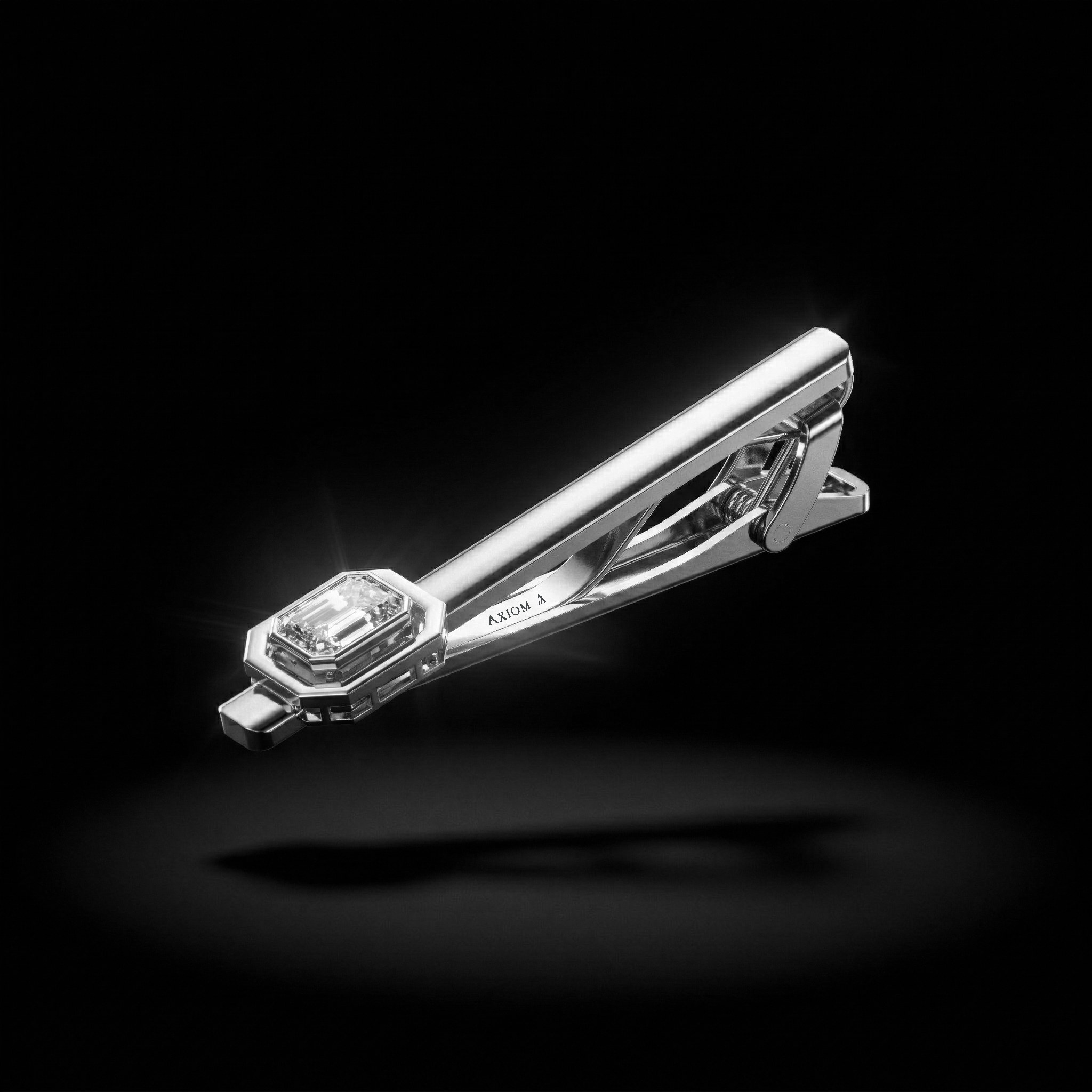
Tie pin, tie clip, tie bar, tie tack: most men use the words interchangeably, and in Indian shops "tie pin" is often the name on a box that actually holds a clip. The differences are real, though, and they decide whether the piece holds your tie properly, whether it leaves a hole in your silk, and whether it looks right in a boardroom.
This guide defines each piece first, then compares them side by side, shows exactly where each one goes against your shirt buttons, and explains when a tie accessory is useful and when it is fussy. It ends with a one-line rule for each item that you can remember at the mirror.
What is the difference between a tie pin, tie clip and tie bar?
The difference is how each one fastens. A tie clip and a tie bar both sit across the tie horizontally and grip the shirt behind it, so nothing pierces the fabric. A tie pin and a tie tack go through the tie.
- Tie bar (slide). A flat, folded bar of metal that slides over both blades of the tie and the shirt placket, held by friction. No spring, no teeth.
- Tie clip. Looks like a bar from the front but opens on a hinge with a spring, and clamps the tie to the shirt. Holds more firmly than a slide.
- Tie pin (stick pin). A long pin with a decorative head, pushed through the front blade of the tie, sometimes with a small cap on the point. The oldest of the four.
- Tie tack. A short pin with a decorative front that passes through both blades of the tie, then fixes to a clutch behind, often with a small chain or bar that anchors through a shirt buttonhole.
Tie pin vs tie clip vs tie bar compared
| Tie bar | Tie clip | Tie pin | Tie tack | |
|---|---|---|---|---|
| How it fastens | Friction slide | Spring hinge | Pierces the tie | Pierces the tie, anchors to shirt |
| Placement height | 3rd to 4th button | 3rd to 4th button | Centre of the tie, a hand's width above the top jacket button | 3rd to 4th button |
| Marks the tie | No | Can, if toothed | Small hole | Small hole |
| Hold | Moderate | Firm | Light | Very firm |
| Formality | Business | Business | Traditional, dressy | Business to formal |
For most men wearing a tie to work, a tie bar or clip is the sensible choice. It does the job, it can be moved between ties without damaging them, and it is easy to put on in the morning.
Where does a tie clip or tie bar go?
By long-standing convention, a tie bar or clip sits between the third and fourth buttons of your shirt, counting the collar button as the first. That is roughly mid-chest, and it is where the tie stays visible in the V of a buttoned two-button jacket. Treat it as a convention rather than a rule: on a tall man or a low-buttoning jacket, one button lower can look better.
How to put it on:
- Tie your tie and adjust it so the tip reaches the top of your belt buckle.
- Find the gap between the third and fourth shirt buttons.
- Slide or clip the bar across the front blade, the back blade and the shirt placket together. All three layers must be inside the bar, or the tie will still swing.
- Set it level, parallel with the floor, not angled.
- Button your jacket and check the bar is still visible in the V. If it disappears, move it up one space.
The width matters as much as the height. The bar should be narrower than the tie at that point, typically half to three-quarters of the tie's width, with three-quarters the figure most style guides settle on. A standard tie of about 8 cm suits a bar of roughly 4 to 6 cm; a slim 6 cm tie needs a bar of 3 to 4 cm.
How to wear a tie pin or tie tack
A tie tack goes at the same height as a bar, between the third and fourth buttons. Push the pin through the front and back blades of the tie, fix the clutch behind, then pass the anchoring chain or bar through the nearest shirt buttonhole. The result is the most secure of the four.
A decorative stick pin goes through the centre of the tie, about a hand's width above the top button of your jacket. On most men that is a little higher than a bar and well below the knot. Push it in through the front blade, catching the back blade if you want it to hold, at the centre where the fabric is thickest, so it is less likely to leave a visible hole. Stick pins are ornamental more than functional and suit a wider tie with some texture.
Is a tie pin necessary?
A tie accessory is not necessary. It becomes useful when your tie is free to move: when you work without a jacket, lean over desks or drawings, walk outdoors in wind, or bend to eat. If you keep a jacket buttoned all day, the jacket already holds the tie in place and the bar is decoration.
In much of India that makes a tie bar more useful than it is in cooler countries. Through a Mumbai or Chennai summer many men wear a shirt and tie without a jacket, which is exactly when a tie swings into the lunch plate. At weddings the question mostly disappears: a bandhgala, sherwani or kurta is worn without a tie, so a tie accessory belongs only to the reception or cocktail suit.
It becomes fussy when it competes. A tie bar, a lapel pin, a patterned pocket square and statement cufflinks all at once is too many small points of metal. Pick one or two. Our guide on men's jewellery for the office covers how much is appropriate in different workplaces.
How to match a tie bar with cufflinks and a watch
Match the metal colour, not necessarily the design. A silver or white-gold tie bar goes with silver cufflinks and a steel watch; a yellow-gold bar goes with gold cufflinks and a gold watch. Mixing colours across the shirt front looks accidental.
A few practical points:
- One piece with stones. If your cufflinks are stone-set, keep the tie bar plain, and the other way round.
- Matched sets work for gifting and weddings, where tie pin and cufflink sets are common, but a matched set is not required for daily wear.
- Watch the lapel. If you wear a lapel pin, it counts as your chest detail. A plain bar is fine alongside it; a jewelled bar may be one too many.
For the other half of the set, see how to wear cufflinks.
How AXIOM approaches this
We make the Lineage Tie Pin in solid 925 sterling silver set with lab-grown white diamonds, so it sits in the same colour family as silver or white-gold cufflinks and a steel watch. Its product page shows the design; if you want to know how it fastens before ordering, a real person replies on WhatsApp, usually the same day. The rest of our tie, lapel and button pieces are in our men's accessories range.
One rule for each
- Tie bar: slide it across both blades and the shirt, between the third and fourth buttons, and keep it narrower than the tie.
- Tie clip: same place as a bar, used when you need a firmer grip.
- Tie pin: centre of the tie, a hand's width above the top jacket button, for a dressy look.
- Tie tack: through the tie and anchored to a shirt buttonhole, for a tie that must not move at all.
