
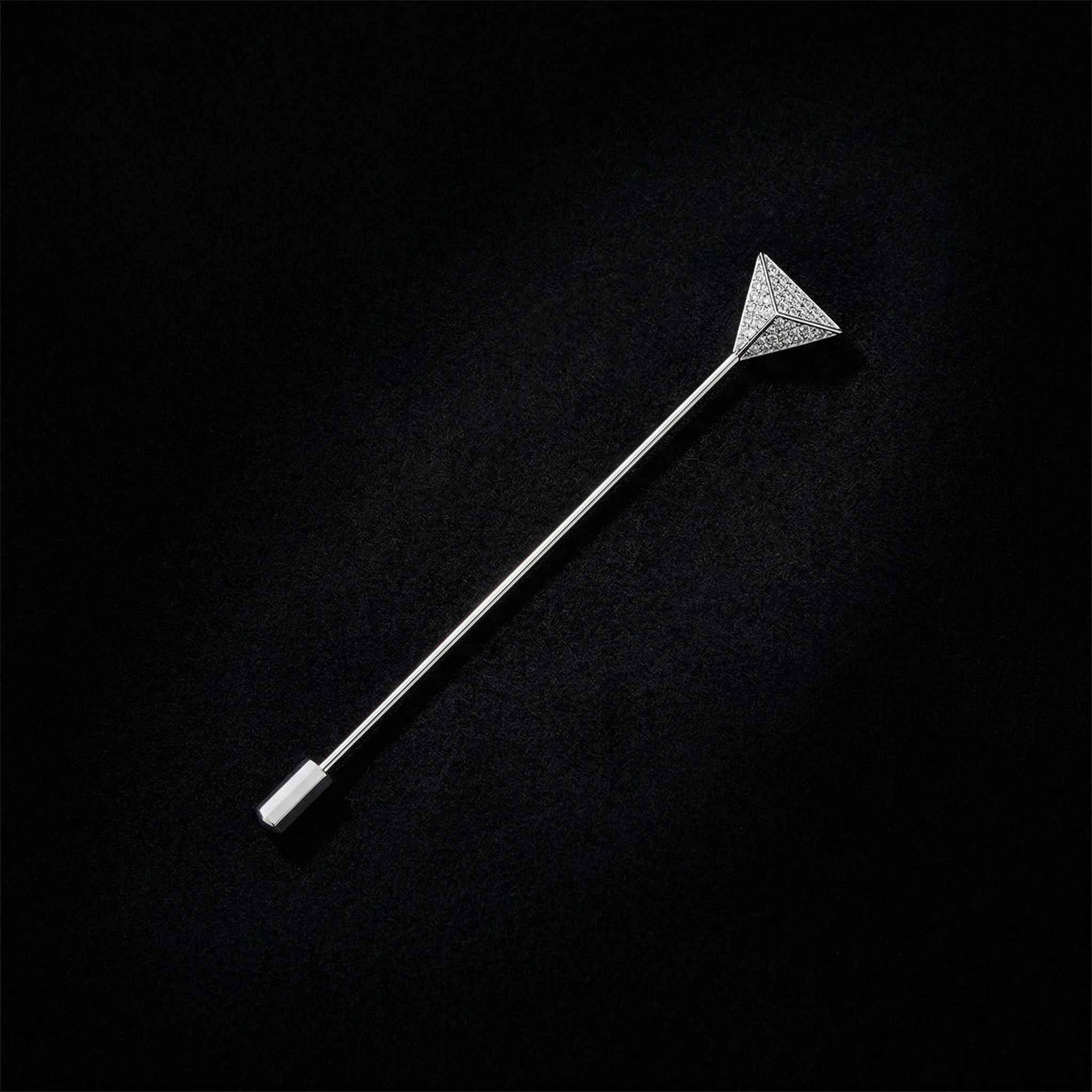
A lapel pin is the smallest piece a man can add to a jacket, and it is also the easiest to get slightly wrong. A pin that sits too high, points the wrong way or fights a pocket square looks like an afterthought. Placed correctly, it looks deliberate, and that is the whole point of wearing one.
This guide explains exactly where the pin goes on a suit or blazer, how to fix it, what a lapel pin means in different settings, how to adapt it for a bandhgala, a Nehru jacket or a shirt, and how it differs from a brooch and a boutonniere. It is written for Indian wardrobes, where the jacket might be a navy suit on Monday and a silk bandhgala at a wedding on Saturday.
Where exactly does a lapel pin go?
A lapel pin goes on the left lapel, as you wear the jacket, at the height of the lapel buttonhole. That buttonhole is cut on the left because it was the historic place for a flower, the boutonniere, and it is still the natural anchor point for anything worn on the lapel today.
You have two good options:
- Through the buttonhole. If the buttonhole is open (a working buttonhole, cut through), push the pin's post straight through it. This hides the post and keeps the pin from shifting.
- Just above the buttonhole. If the buttonhole is only stitched for show, or the pin's design would be hidden by the hole, fix it a finger's width above, in line with the hole.
Either way, the pin should sit on the flat part of the lapel, not across the roll line where the lapel folds back, and not above the notch where lapel meets collar.
How to wear a lapel pin on a suit, step by step
- Find the buttonhole on the left lapel. On most jackets it sits a few centimetres below the notch.
- Take off the clutch (the small back that grips the post) and set it somewhere you will not lose it.
- Hold the pin at an angle so the design runs parallel to the outer edge of the lapel, not straight up and down with the floor.
- Push the post through from the front, either through the buttonhole or through the fabric just above it. Go straight in so you make one clean hole.
- Fix the clutch firmly behind the lapel. On a stone-set pin, use the locking clutch if it has one.
- Check it in a mirror with the jacket buttoned. The pin should look level with the lapel edge and should not tilt forward.
The angle is the step most men miss. A lapel runs diagonally from the shoulder towards the button, so a pin set dead vertical looks crooked against it. Aligning the pin with the lapel's edge makes it look as if it belongs to the jacket.
What size should a lapel pin be?
As a working rule, a lapel pin should take up no more than about half the width of the lapel at the point where it sits. A standard suit lapel is roughly 7 to 9 cm wide at its widest, narrower on slim cuts, so a pin with a face of 1.5 to 3 cm usually looks balanced. Slim lapels need smaller pins; a peak lapel on a double-breasted jacket can carry a slightly larger one.
Weight matters as much as size. A heavy pin on a soft, unstructured jacket will drag the lapel forward. If your jacket has no canvas or fused interlining, choose a lighter pin.
What does a lapel pin mean?
A lapel pin means whatever its design says. People wear lapel pins to show belonging, mark an occasion or simply finish a jacket. The main categories are:
| Pin type | What it signals | Where it is usually worn |
|---|---|---|
| Flag pin | National pride | Official events, national days |
| Emblem or logo pin | Membership of a company, club, school or service | Work, reunions, formal functions |
| Commemorative pin | A specific event, anniversary or cause | The event itself |
| Jewelled or decorative pin | Personal style, no specific message | Weddings, receptions, evenings |
In India the English term is used as it is, in Hindi speech and in shop listings alike. The meaning is carried by the design, not by the word.
When is a lapel pin too much?
A lapel pin is too much when it competes with something else on the chest. Wear one pin, and if you add a pocket square, keep it simple and let the pin be the detail. A pin, a flower and a patterned pocket square together crowd the lapel.
Formality changes the rules:
- Business: a small, quiet pin is fine. Company emblems are common and accepted.
- Black tie: traditionally the lapel is left clear or carries a single flower. A small jewelled pin is a modern choice and optional, not expected.
- Wedding guest: a decorative pin is welcome, but avoid anything that could read as a groom's piece.
- Mourning and religious services: skip decorative pins, or wear only a meaningful emblem.
How to wear a lapel pin with a bandhgala, blazer or shirt
The same principle holds on every garment: left side, upper chest, angled with the line of the fabric.
On a bandhgala or Nehru jacket, there is no lapel. Place the pin on the left side of the chest, about level with the second or third button and roughly halfway between the buttons and the armhole. Align it with the edge of the front placket or keep it straight if the jacket has no diagonal lines. A brooch is equally at home here and is often the better choice for a wedding look. Our guide to the brooch for men covers larger chest pieces.
On a blazer, treat it exactly like a suit lapel. Blazers are more relaxed, so enamel or novelty pins sit more comfortably here than on a dark suit.
On a shirt or polo, place a light pin on the left chest where a pocket would be. Stiff fabrics hold a pin better than thin cotton or knit, which will sag around the post.
Lapel pin vs brooch vs boutonniere
These three do the same job, adding one point of interest on the chest, but they differ in size, fastening and formality.
| Item | Fastening | Typical size | Best for |
|---|---|---|---|
| Lapel pin | Straight post and clutch through the lapel | Small, face under about 3 cm | Suits, blazers, daily jacket wear |
| Brooch | Hinged pin and catch along the back | Larger, often 4 cm and up | Bandhgalas, sherwanis, evening wear |
| Boutonniere | Flower stem through the buttonhole or pinned | Single bloom | Weddings and formal events |
Wear one of the three at a time. If you are the groom and the family has asked for a flower, the flower wins that day.
How to care for a stone-set lapel pin
A stone-set lapel pin needs the same care as a ring, with one extra check: the post and clutch. A worn clutch is how most pins get lost.
- Check the clutch every few wears. If it slides off the post easily, replace it.
- Put the pin on after perfume and hair products, not before, so chemicals do not film over the stones.
- Wipe silver pins with a soft silver cloth to remove tarnish. Do not use a toothpaste or abrasive paste on stone-set pieces.
- Store it separately in a soft pouch so the post does not scratch other pieces.
- Take it off before the jacket goes to the dry cleaner. Pins are lost in cleaning bags more than anywhere else.
How AXIOM approaches this
We make our lapel pins in 925 sterling silver rather than plated base metal, and we set them with diamonds rather than enamel so they read as jewellery on a dark jacket. The Insignia Lapel Pin and the Sovereign Lapel Pin are both 925 sterling silver with lab-grown white diamonds, and the Aegis Lapel Pin pairs natural black diamonds with lab-grown white diamonds. The rest of the range, including tie pins and buttons, is in our men's accessories category.
For the pieces that sit alongside a lapel pin, see our guides on how to wear cufflinks and the tie pin vs tie clip.
The practical takeaway
Left lapel, at the buttonhole or just above it, angled with the lapel edge, one pin at a time. Size it to about half the lapel width, check the clutch before every event, and if the day calls for a flower, leave the pin in its box.
