
Most sherwani guides are written by clothing brands, so jewellery arrives as a last line: "add a brooch and a mala". That leaves the groom with real questions. How many buttons does the sherwani need, which side the brooch goes on, whether silver works with gold zari, and what to wear on the four other days of the wedding. This checklist answers each one from the bench side, by people who make men's jewellery for a living.
It applies to Hindu, Sikh, Jain and Muslim weddings where the groom wears a sherwani, achkan or bandhgala, though every family and region has its own customs. For the full picture of what grooms wear from Punjab to Kerala, see our guide to Indian groom jewellery traditions.
What jewellery does a groom wear with a sherwani?
A groom wears jewellery in three zones: the front of the sherwani (buttons, brooch, mala), the head (kalgi or sarpech on the safa) and the hands (ring, kada or bracelet). Everything else is optional. The table below lists each piece, where it sits and whether most grooms treat it as essential.
| Piece | What it is | Where it sits | Essential or optional |
|---|---|---|---|
| Sherwani buttons | Detachable decorative buttons fixed through the buttonholes | Front placket, sometimes cuffs | Essential if the sherwani has buttonholes |
| Brooch | A decorative pin, often with a safety catch or two pins | Left chest | Common, strongly recommended |
| Mala or haar | A necklace, usually pearls or beads, sometimes with a pendant | Over the sherwani, falling to mid-chest or lower | Traditional in many regions, optional |
| Kalgi or sarpech | A turban ornament: a plume or a jewelled feather shape | Front or side of the safa | Traditional where a safa is worn |
| Ring | Usually the engagement ring from the sagai or roka | Ring finger | Essential for most grooms |
| Kada or bracelet | A rigid bangle or a flexible bracelet | Wrist, visible at the cuff | Optional; an article of faith for Sikh grooms |
| Cufflinks | Fasteners for double cuffs | Shirt cuffs, for the reception suit | Needed only with French cuffs |
Two pieces are functional rather than decorative. Buttons close the sherwani, and cufflinks close the shirt. Get those right first, then add the others.
The groom jewellery checklist for every function
Each function calls for a different weight of jewellery, from almost nothing at the haldi to the full set at the pheras or nikah. The order and names of functions differ between communities, so treat this as a template rather than a rule.
| Function | Typical outfit | Jewellery | Metal and stone suggestion |
|---|---|---|---|
| Roka, sagai or engagement | Bandhgala, Indo-Western jacket or suit | The engagement ring, a lapel pin or small brooch, a watch | Match the ring's metal; one diamond accent is enough |
| Haldi | Old white or yellow kurta you do not mind staining | The ring only, or nothing | Remove brooches and buttons: turmeric paste stains fabric and settles into settings |
| Mehendi | Kurta with a light jacket or Nehru jacket | Kurta buttons, a thin chain or bracelet | Silver or gold; keep hands light, since henna will be applied |
| Sangeet | Indo-Western, bandhgala or embroidered kurta | Brooch, kada or bracelet, statement ring | The one night for a bolder piece, such as a black diamond brooch |
| Baraat, pheras or nikah | Sherwani or achkan with safa | Full set: buttons, brooch, mala, kalgi or sarpech, ring, kada | One metal tone throughout; stones picked from the embroidery |
| Reception | Tuxedo, suit or bandhgala | Cufflinks, lapel pin or brooch, ring, watch | Silver or white metal reads best under stage lighting on dark suits |
Two practical notes the clothing guides skip. At the haldi, take off anything you care about, because turmeric paste stains fabric and works its way into chains, pavé and engraving. At the mehendi, avoid rings on the hand being decorated, as henna paste gets into settings and is tedious to clean.
How to wear each piece correctly
Every piece has a correct position, and most mistakes come from putting two statement pieces in the same spot. Here is the placement for each.
Sherwani buttons
Detachable sherwani buttons are fixed through the buttonholes and held at the back by a small ring, a toggle or a chain that links the set. Sets commonly pair larger buttons for the front placket with smaller ones for the cuffs, but counts vary from sherwani to sherwani, so count your buttonholes before you buy. Our sherwani buttons guide explains the types and how to fit them.
Brooch
The brooch sits on the left side of the chest, about a hand's width below the collarbone. A heavy brooch on thin silk will pull the fabric forward, so choose one with two pins or add a small square of felt behind the fabric to spread the load. A chain brooch, with a fine chain running from the brooch towards the buttons, suits a plain sherwani. Our guide to the brooch for men covers designs and sizes.
Mala or haar
The mala sits over the sherwani and should end between mid-chest and just above the waist. Rule of thumb: the busier the embroidery, the simpler the mala. A single strand suits a heavily worked sherwani, while a plain raw silk or velvet sherwani can take two or three layers. If you wear both a mala and a brooch, make sure the mala does not cover the brooch when you sit.
Kalgi and sarpech
A kalgi is pinned to the front or side of the safa, usually where the folds gather. It is traditionally a plume shape. The sarpech is the grander, jewelled version: museum pieces such as this sarpech at the Cleveland Museum of Art were fixed to the front of the turban and shaped like an eagle feather or plume, as an emblem of high rank. If a sehra is also worn, the kalgi sits above it and the two must not fight for the same space, so try them on together.
Ring
For most grooms this is the ring exchanged at the sagai, roka or engagement. It is also the piece photographers shoot at close range during the ring ceremony and the pheras, so it should be clean and properly sized. If you have not bought it yet, choose a metal you are happy to wear every day, because this is the piece most grooms keep on after the wedding.
Kada or bracelet
A kada should show a few millimetres beyond the sherwani cuff when your arm hangs naturally. For Sikh grooms the kara is an article of faith worn every day, not an accessory choice, and nothing in this checklist is meant to replace or restyle it. For other grooms, a kada or bracelet is optional and works best in the same metal as the buttons.
Cufflinks
Cufflinks only matter for the reception, when a shirt with double cuffs goes under a suit or tuxedo. Match their metal to the watch case and lapel pin, not to the wedding sherwani.
Which metal goes with which sherwani colour?
Match the metal to the embroidery, not to the base fabric. A cream sherwani with gold zari wants gold-toned jewellery, while the same cream with silver or self-coloured thread wants silver-toned. That single rule settles most colour questions.
| Sherwani colour | Metal tone | Stones that work | What to avoid |
|---|---|---|---|
| White or ivory with gold zari | Yellow gold or gold-toned | Pearls, polki, emeralds | Silver buttons, which look borrowed |
| White or ivory with silver or tonal thread | Silver or white gold | White diamonds, pearls, black diamonds | Heavy yellow kundan |
| Gold, beige or champagne | Yellow gold | Pearls, polki, rubies | Mixing silver and gold in the same zone |
| Pastels (mint, powder blue, blush) | Silver, white gold or soft gold | Pearls, white diamonds, pale stones | Heavy dark stones that look severe |
| Black, midnight blue or bottle green | Silver or white gold | White diamonds, black diamonds, emeralds | Too many coloured stones at once |
| Red or maroon | Yellow gold | Rubies, polki, pearls | Cool silver, which can look flat against red |
For a white sherwani specifically, the fabric is the statement. Keep jewellery quieter than you would on a coloured sherwani, since every piece shows against plain white.
How many statement pieces should a groom wear?
Wear one statement piece and let everything else support it. If the mala is layered and heavy, choose small buttons and a modest brooch. If the brooch is large, wear a single-strand mala or none at all.
Think about what the camera sees. In a half-length portrait, the brooch, mala and kalgi are all in frame together, so three large pieces compete for attention. Buttons read from across a room. The ring and kada appear in close-ups during the ring exchange and the pheras. Spread the interest across those distances instead of stacking it in the chest area.
Comfort matters too. The baraat and ceremony together can run for several hours, often in heat. A heavy mala pulls on the neck, a large sarpech pulls the safa forward, and a brooch on thin silk drags the fabric. Wear the full set at your final fitting for at least an hour before the wedding.
Should you buy, rent or reuse family jewellery?
Buy the pieces you will wear again and rent the pieces you will not. Buttons, a ring, a kada, cufflinks and a brooch all return to your wardrobe after the wedding, for festivals, other people's weddings and formal events. A kalgi, sarpech and layered mala rarely do.
| Piece | Worn again after the wedding? | Sensible approach |
|---|---|---|
| Ring | Daily, for many grooms | Buy, in a metal you can wear every day |
| Buttons | At festivals, weddings, formal dinners | Buy, or reuse a family set |
| Brooch | On bandhgalas, jackets, kurtas | Buy |
| Kada or bracelet | Often daily | Buy |
| Cufflinks | With formal shirts | Buy |
| Mala | Rarely | Rent, borrow or buy a costume piece |
| Kalgi or sarpech | Rarely | Rent, borrow, or reuse a family piece |
Family pieces carry meaning that nothing new can match, and many grooms wear a father's or grandfather's buttons or kada. Have old pieces checked by a jeweller before the wedding: worn clasps, loose stones and bent pins are common in older jewellery. For costs item by item, see our groom jewellery budget guide.
A simple plan for the wedding week
Jewellery gets lost in wedding weeks more often than it gets damaged. A little organisation prevents most problems.
- Finalise the sherwani first, then choose jewellery to match its embroidery, not the other way round.
- Order anything made to order at least six to eight weeks ahead, allowing for delivery and any resizing.
- Do one full dress rehearsal with every piece on, including the safa and kalgi, and photograph it in daylight.
- Pack each function's jewellery in its own labelled pouch.
- Give one trusted person, usually a brother or cousin, the job of carrying the pouches and collecting pieces after each function.
- After the wedding, wipe each piece with a soft dry cloth before storing, since sweat, perfume and haldi residue dull metal over time.
How AXIOM approaches this
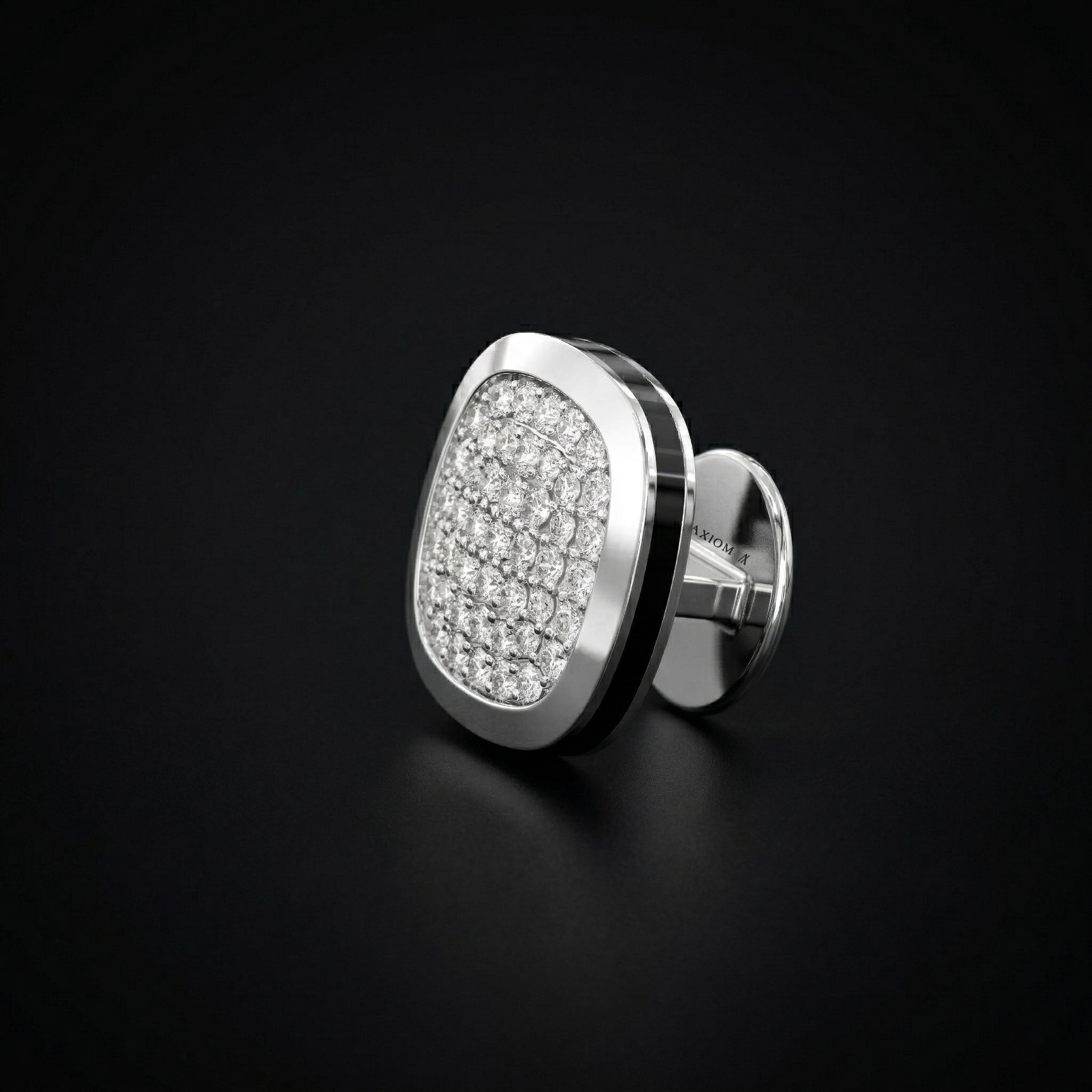
AXIOM makes the pieces that stay in a man's wardrobe after the wedding, not the one-day ones. Our accessories include detachable buttons, lapel pins and cufflinks, such as the Herald Buttons in 925 sterling silver with lab-grown white diamonds. We do not stock kalgis, sarpechs or malas, so grooms who want one to match their buttons commission it through our bespoke service, and every piece is made to order at the Bharat Diamond Bourse in Mumbai. The wedding gifts page gathers rings, kadas and accessories suited to the occasion.
The practical takeaway
Choose the sherwani, read its embroidery, and pick one metal tone. Buy the ring, buttons and kada you will wear for years, rent or borrow the kalgi and mala, and allow only one piece to be the statement. Then wear the whole set for an hour before the day, so nothing surprises you in the mandap.
