
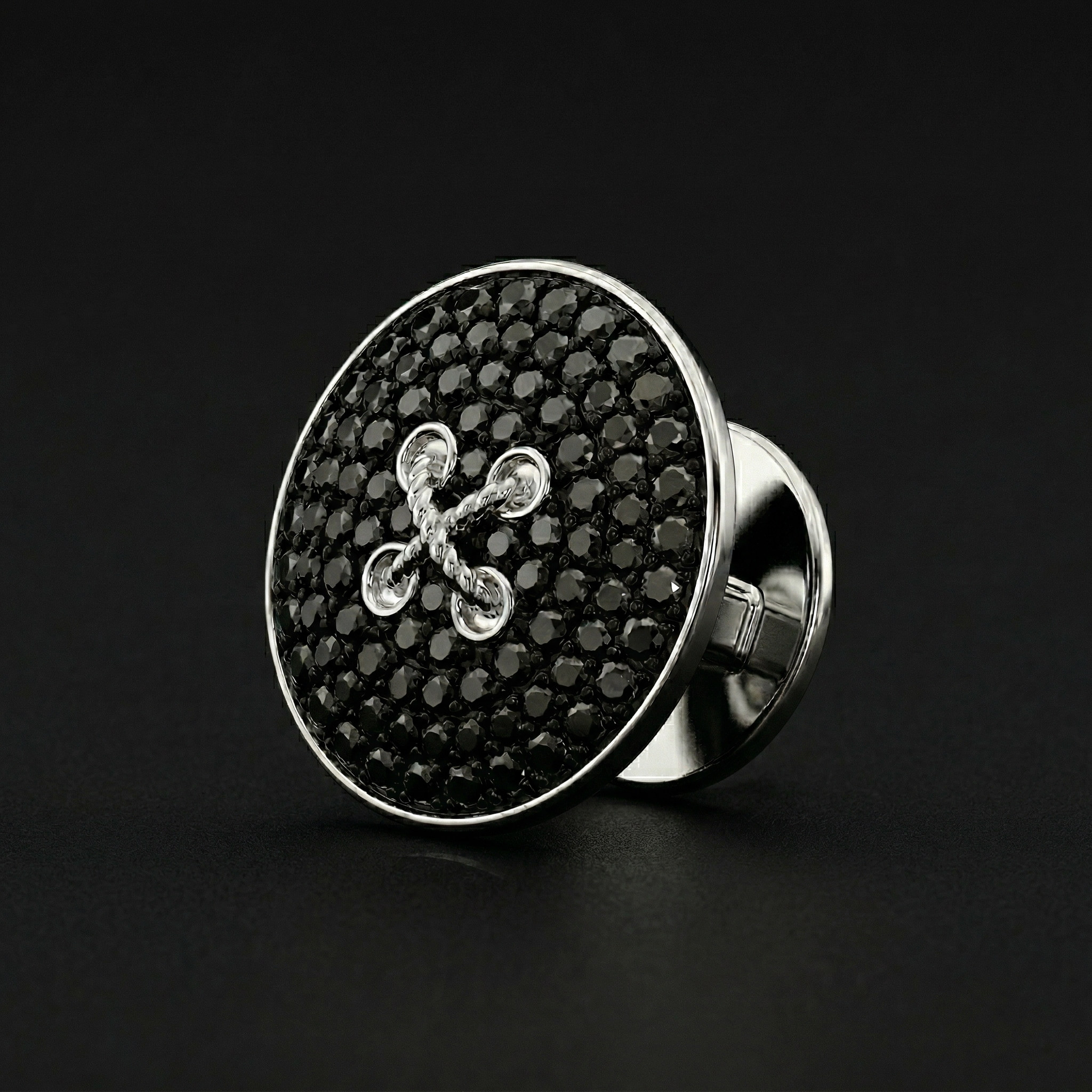
Detachable buttons are the most practical piece of men's festive jewellery. They sit on every kurta, sherwani and bandhgala you own, they are never in the way, and a good set outlasts the garment it was bought for. Yet most sherwani buttons are sold with no explanation of how they fasten, how many a garment needs, or how to keep them from going missing.
This guide covers the three fastening types, how to fit them step by step, how many buttons each garment takes, and how to match them with a brooch and cufflinks. For the full wedding picture, see our groom jewellery for sherwani checklist.
What are sherwani buttons?
Sherwani buttons are decorative buttons made to be removed and reused. Instead of being sewn on, they pass through the garment's buttonholes and are fixed from the inside. The same buttons can move from a wedding sherwani to a Diwali kurta to a bandhgala at a formal dinner.
They range from brass and gold-plated costume sets to fine jewellery in sterling silver or gold set with diamonds, pearls or coloured stones. Kurta buttons are the same idea at a smaller scale, usually for a shorter placket.
Which types of detachable buttons are there?
There are three main fastenings. Each has a different feel on the garment and a different risk of loss.
| Type | How it fastens | Best for | Watch out for |
|---|---|---|---|
| Stud with a back | A post passes through the buttonhole and a bar, toggle or screw back locks it | Kurtas, shirts, lighter fabrics | Small backs are easy to drop when fitting |
| Loop or shank with ring | A loop at the back of the button passes through the hole and a small ring or pin threads through the loop | Sherwanis, achkans, heavier fabrics | The ring must be closed fully or the button works loose |
| Chain-linked set | Buttons joined by a fine chain at the back, fitted one after another | Kurtas, bandhgalas | Chain length must match the spacing of your buttonholes |
A fourth style, sometimes called kurta buttons with chain, has a decorative chain on the front, draped between two buttons. It is a styling choice rather than a fastening, and it suits a plain kurta better than an embroidered sherwani.
How to put on sherwani buttons
Fitting takes about five minutes the first time. Do it before you dress, with the garment laid flat.
- Remove any placeholder buttons. Many sherwanis and kurtas come with plain buttons loosely sewn over working buttonholes. Snip the thread carefully and keep the originals.
- Lay the set out in order. If the set has two sizes, separate front buttons from cuff buttons.
- Start at the collar. Push the first button's loop or post through the top buttonhole from the outside.
- Lock it from the inside. Thread the ring through the loop, or fit the back onto the post, and close it fully.
- Work downwards. Check each button faces the same way before fixing the next, especially if the design has a top and bottom.
- Do the cuffs last. Cuff buttons are smaller and easier to fit with the sleeve turned slightly inside out.
- Test by moving. Sit, raise your arms and turn. Nothing should twist or tug at the fabric.
For chain-linked sets, fit the top button first, then feed each following button through its hole in order so the chain lies flat behind the placket.
How many buttons does each garment need?
Count the buttonholes on your own garment before buying, because cuts vary widely. The table shows what to expect and what suits each garment.
| Garment | Where the buttons go | Style suggestion | Occasion |
|---|---|---|---|
| Kurta | Short front placket | Small studs or a chain-linked set | Festivals, pujas, mehendi, sangeet |
| Nehru jacket | Full front | Flat or low-domed buttons that lie close | Festive evenings, office Diwali |
| Bandhgala or Jodhpuri | Full front, sometimes cuffs | Structured buttons, one metal tone | Receptions, formal dinners |
| Sherwani | Full front, often cuffs | Larger front buttons with matching smaller cuff buttons | Weddings, baraat, pheras or nikah |
| Achkan | Long front placket | A longer set in a quieter design | Weddings, formal ceremonies |
Online listings commonly sell sherwani sets as larger front buttons plus smaller cuff buttons. If your sherwani has more buttonholes than the set, ask the maker for extras in the same design rather than mixing sets.
Which metal and design suit your outfit?
Match the button metal to the embroidery, not the fabric. Gold zari calls for gold-toned buttons, while silver, pearl or tonal embroidery calls for silver-toned ones.
A few principles make the choice easier:
- Scale. Buttons for a sherwani front are usually visibly larger than kurta buttons. Very large buttons on a slim frame look heavy.
- Shape. Round and domed shapes are traditional. Square, hexagonal and flat geometric shapes read as modern and suit bandhgalas.
- Stones. White diamonds or pearls brighten a dark garment. Black diamonds or onyx give a quieter look on ivory or pastel.
- Busy fabric, simple buttons. A heavily embroidered sherwani needs plain buttons, while a plain raw silk or velvet can carry more detail.
How to match buttons with a brooch and cufflinks
Keep one metal tone across the chest and wrists, and let only one piece be the statement. If the buttons carry diamonds, choose a simpler brooch, and the other way round.
| Pieces worn together | What should match | What can differ |
|---|---|---|
| Buttons and brooch | Metal colour | Motif and size |
| Buttons and cufflinks | Metal colour, ideally stone colour | Shape |
| Buttons, brooch and kalgi | Metal colour across all three | Design, as long as one piece leads |
Our guide to the brooch for men covers placement on a kurta, bandhgala and sherwani. For the reception suit, see how to wear cufflinks.
How to care for and store detachable buttons
Buttons are small, so they are lost more often than they are damaged. Good storage solves most problems.
- Remove before washing or dry cleaning. Always. Solvents, heat and tumbling are hard on settings, and a button lost at the cleaner's rarely comes back.
- Wipe after each wear. Use a soft dry cloth to remove sweat, perfume and make-up, which dull metal over time.
- Store as a set. Keep each set in one pouch or a compartment box, with the rings or backs in the same place.
- Protect silver from air. Sterling silver tarnishes when exposed to air and moisture. A sealed pouch with an anti-tarnish strip slows it down.
- Check before each event. Look for loose stones and bent loops, and make sure every ring or back is present.
If a silver set has darkened, a silver polishing cloth usually brings it back. Take diamond-set buttons to a jeweller rather than using dips, which can harm some stones and finishes.
How AXIOM approaches this
AXIOM makes detachable buttons as fine jewellery rather than trims. The Herald Buttons, in 925 sterling silver with lab-grown white diamonds, are designed to replace a garment's standard buttons and are listed from ₹45,000 at the time of writing. The Regent Button, in 925 sterling silver with natural black diamonds, is made for jackets and bandhgalas, from ₹55,900 at the time of writing, and is also offered as a matching cufflink or a complete formal set. The Crest Buttons, designed to anchor a shirt, sit alongside them in our accessories with pricing on request.
The practical takeaway
Count your buttonholes, choose the fastening that suits the fabric, and match the metal to the embroidery. Fit the buttons from the collar down, test them by moving, and store each set together. Bought well, one set will dress every festive outfit you own for years. For more on dressing a kurta, see our guide to men's jewellery with a kurta.
