
Most Indian families hold jewellery that nobody wears: a grandfather's ring two sizes too small, a mother's bangles, loose stones from a necklace taken apart years ago. Guides to heirloom redesign are almost all written by UK, US and Australian jewellers for engagement rings. This one is for an Indian man turning family gold and stones into a piece he will actually wear, and for the parent or sibling commissioning it for him.
Restore, recreate or redesign?
Decide which of three things you want before you speak to a jeweller, because each one treats the original differently.
| Route | What happens to the original | Best when | What survives |
|---|---|---|---|
| Restore | Repaired, resized and refinished | He likes the design and it only needs fitting | Everything |
| Recreate | Copied as a new piece; the original stays with the family | The original is worn thin or another relative wants it | The design |
| Redesign | Melted and its stones reused in a new design | Nobody will wear it as it is, but the material matters | The metal and the stones |
A grandfather's ring that is simply too small is a restoration job. A mother's 22K bangles that will never suit a man are a redesign. When two brothers each want something from one piece, a redesign can split the metal and stones between two smaller rings.
How to redesign inherited jewellery, step by step
- Photograph and weigh everything. Photograph each piece from several angles and note its weight in grams. This is your record before anything is changed.
- Have the gold tested. If the pieces carry no hallmark, get a purity report from a BIS-recognised Assaying and Hallmarking Centre (see below).
- Agree within the family. Decide who keeps what before anything is melted. Melting cannot be undone.
- Choose the route and the design. Restore, recreate or redesign; then collect reference photos and his ring size in millimetres.
- Get a written quote. It should state the karat of the finished piece, the weight of your metal going in, metal added, expected finished weight, melting and finishing loss, and making charges.
- Have the stones removed and checked. A jeweller should take stones out before any heat work and inspect each one under magnification.
- Approve a CAD render. Check the top, side and inside views with dimensions in millimetres.
- Collect with paperwork. The invoice should list the finished weight, karat and every stone reused or added.
Our guide to the custom jewellery design process explains each bench stage from CAD to casting.
How to test old gold before you redesign it
Test first, so you know what you are working with. A consumer can have unhallmarked gold jewellery tested at any BIS-recognised Assaying and Hallmarking Centre and receive a purity report. When the scheme was announced in March 2022, the PIB release on testing unhallmarked jewellery put the charge at Rs 200 for up to four articles and Rs 45 per article for five or more; charges can be revised, so ask the centre what it charges today. The ring made from that gold can then be hallmarked like any new piece, through a BIS-registered jeweller.
If your pieces are already hallmarked, read the marks. Gold sold in mandatory hallmarking districts must carry the BIS logo, the purity grade (such as 22K916 or 18K750) and a six-character HUID, and hallmarked jewellery bought under older schemes remains valid, as the PIB notice on HUID hallmarking confirms. A hallmark tells you the karat before you hand anything over.
What happens to the gold when it is melted?
Melting does not change how much pure gold you own; it changes what that gold is mixed with. A jeweller melts your pieces and then alloys the result to the karat you choose, adding fine gold or alloy metals as needed.
The arithmetic matters for a man's ring:
| Starting gold | Fine gold in 10 g | Becomes, if made into 18K | Becomes, if made into 22K |
|---|---|---|---|
| 22K (916) | 9.16 g | About 12.2 g of 18K, with alloy added | 10 g of 22K |
| 18K (750) | 7.5 g | 10 g of 18K | Not by melting alone: the alloy must be refined out, or about 20 g of fine gold added to each 10 g, giving about 30 g of 22K |
So 22K family gold stretches further as 18K, and 18K cannot become 22K without refining or buying a large amount of fine gold. These figures ignore melting and finishing loss, which every jeweller should state separately.
Two further cautions. Old jewellery often contains solder joints, and mixed lots of different karats or colours can melt into an uneven result, so ask the jeweller how they will refine or adjust the metal. And 22K is soft for a man's daily ring; 18K is the more common choice for a band worn every day.
Can a family diamond be reset into a men's ring?
Usually, yes, but check the stone before you design around it. GIA notes that a diamond can chip or cleave from a hard blow during setting or wear, and that diamonds burn at about 850°C, a temperature a jeweller's torch can reach. That is why stones must come out before the old metal is heated or melted.
| Inherited stone | What to expect | Men's setting that suits it |
|---|---|---|
| Modern round brilliant | Resets easily | Flush, bezel or a low four-claw setting |
| Old mine or old European cut | Deeper, softer-looking sparkle; valued as antique cuts | Bezel, which wraps and protects the girdle |
| Rose cut | Flat base, faceted dome; shallow | Bezel or a closed setting |
| Polki (uncut diamond) | Flat, unfaceted; traditionally set in kundan or jadau work | Usually best kept in a pendant or button rather than a daily ring |
| Small accent stones | Many tiny stones from an old piece | A channel or flush row across a band |
Recutting an old stone into a modern brilliant is possible, but it reduces the weight and removes the antique character that made it family history. Most families keep the cut and choose a setting that protects it.
Gold is not the only option for the new setting. A family diamond can be set in 18K white gold, or in 925 sterling silver for a much lower metal cost. Our guide to setting diamonds in silver covers how that holds up.
Redesign ideas that work for men
- A signet from a grandfather's ring. Melt a worn ring into a signet with the family initial or the original date engraved inside.
- A band with one family stone set flush. Low, protected and easy to wear daily.
- Two matching bands from one piece. Split the gold between brothers, each with a share of the stones.
- A kada from bangles. Several thin bangles can provide the weight for one kada, if the karat is right.
- A pendant for polki or a large stone. Keeps a fragile or unusual stone off the hand.
- An exact recreation. The same ring as his father's, made new in his size.
What does redesigning old jewellery cost?
You pay for the work, not for the gold and stones you already own. The bill usually covers design and CAD, casting, stone setting, finishing and polishing, any metal or stones added, and the metal lost in melting and finishing.
Ask for each item separately. A quote that says only "making charges included" makes it impossible to compare two jewellers or to check how much of your own gold came back. Our explainer on gold making charges shows how per-gram and percentage charges work.
Questions to ask before you hand over family jewellery
- Will you weigh and photograph the pieces with me before taking them?
- What karat will the finished piece be, and how will you reach it?
- How much of my metal goes in, how much is added, and what weight comes back?
- What is the expected loss in melting and finishing, in grams?
- Will you remove and inspect the stones before heating, and tell me about any damage?
- Will I approve a CAD render before casting?
- What paperwork will I receive at the end?
How AXIOM approaches heirloom commissions
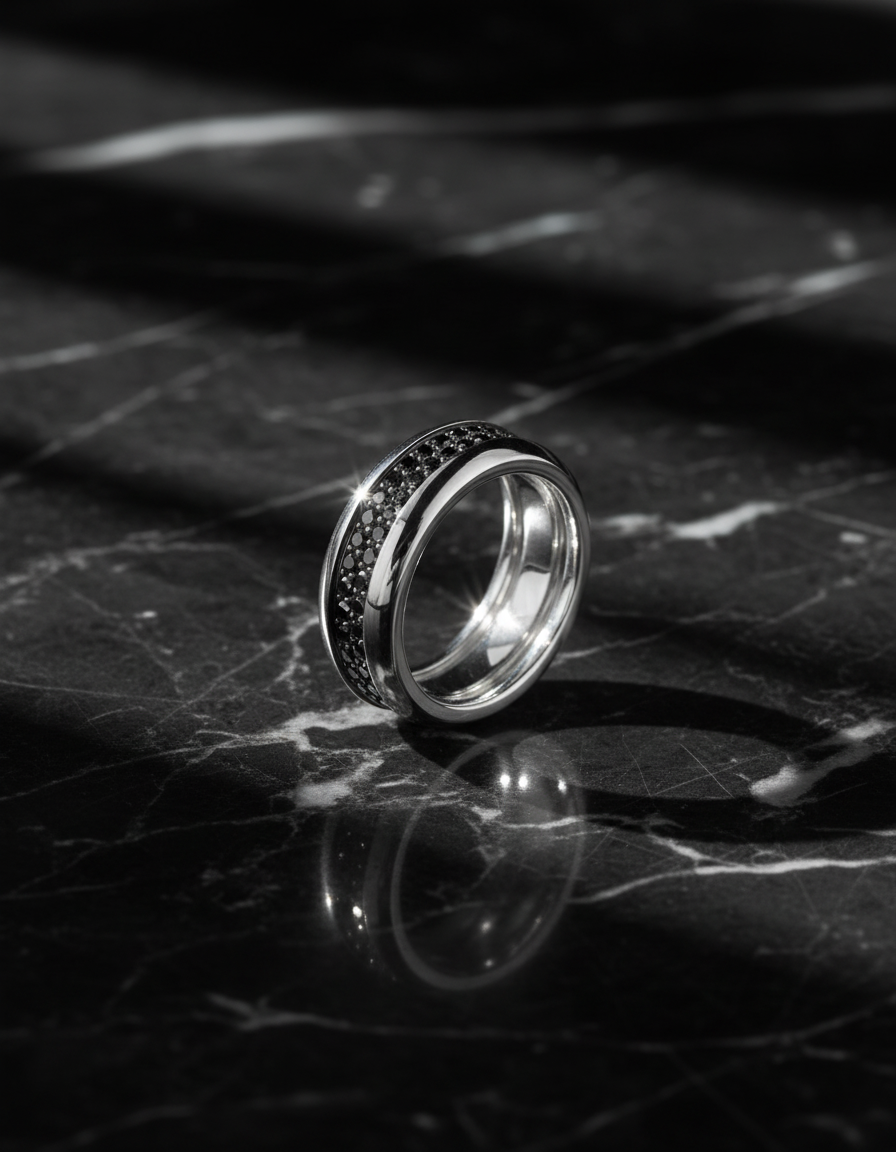
Recreating a piece a client already owns is one of the commissions listed on AXIOM's bespoke page. You share a photo, a sketch or the heirloom itself and the team replies within a day; the design is refined through sketches and CAD until you sign off, then cast, set and finished by hand at the Bharat Diamond Bourse, with no deposit to begin. For a sense of a low, stone-protecting men's setting, the Oath Band sets two rows of natural black diamonds in 925 sterling silver.
The practical takeaway
Photograph, weigh and test before anything is melted, and agree within the family first. Then insist on three numbers in writing: the karat of the new piece, the weight of your metal going in, and the weight coming back. Get those right and the rest is design.
