
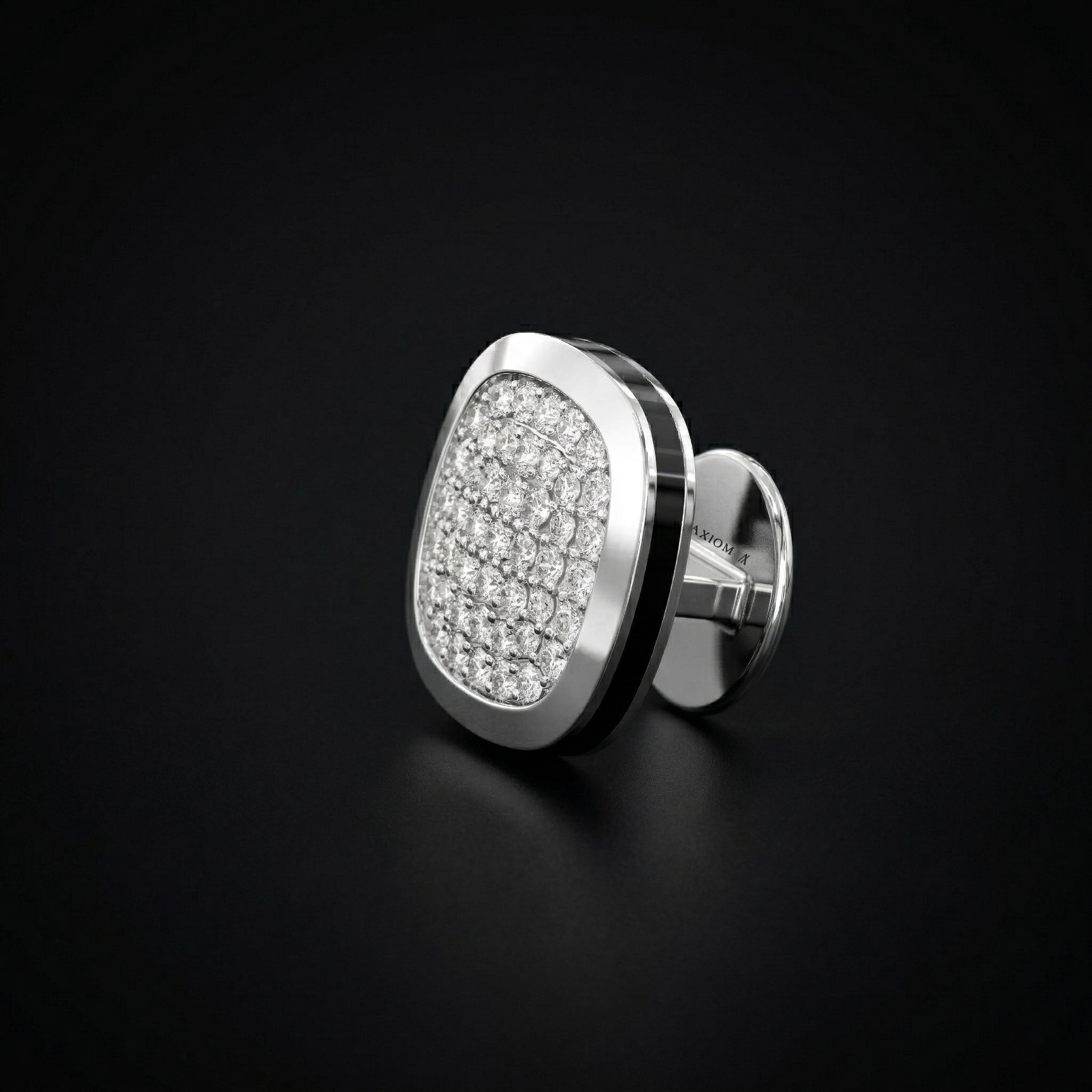
Search for a jewellery manufacturer in India and you get directory listings: hundreds of suppliers, prices from a few rupees to lakhs, and no way to tell a brass casting unit from a diamond bench. If you run a store, a brand, a corporate gifting business or a wedding service, and you want men's pieces made under your name or supplied to your floor, the useful questions are different. What model do you need, what should the manufacturer put in writing, and how does a run actually work?
What kinds of custom jewellery manufacturers are there in India?
There are two quite separate industries under the same search term: fashion jewellery manufacturers and fine jewellery manufacturers. Directory pages mix them, which is why one listing page can show prices from double digits to tens of thousands of rupees per piece.
| Type | Typical materials | Typical price per piece | Who it suits |
|---|---|---|---|
| Fashion or imitation | Brass, alloy, stainless steel, plated finishes | Low, often a few hundred rupees | Fashion labels, promotional and event gifts |
| Silver and demi-fine | 925 silver, plated silver, some stones | Moderate | Silver brands, gifting businesses |
| Fine jewellery | Gold, 925 silver, platinum, natural and lab-grown diamonds | High, set by metal weight and stones | Jewellers, fine jewellery brands, bespoke services |
Mumbai is the centre of the fine jewellery and diamond side. The Bharat Diamond Bourse in the Bandra Kurla Complex describes itself as the world's largest diamond exchange, with over 4,000 members in the import, export, manufacturing and marketing of diamonds, and jewellery benches work around it. Our guide to the Bharat Diamond Bourse explains how the Bourse works and who can enter.
Which way of working with a manufacturer suits you?
Pick the model before the manufacturer, because it decides what you need to negotiate. Most fine jewellery makers offer some combination of four models.
| Model | What you get | What you control | Best for |
|---|---|---|---|
| Wholesale supply | The maker's own designs, bought at trade pricing to stock | Selection and quantity | Stores adding a men's range quickly |
| White label | Pieces made to your specification, sold under your brand | Design, finish, branding, packaging | Brands building their own line |
| Shop-in-shop | A maker's counter or range inside your store | Floor space and sales | Stores wanting depth without designing |
| Bespoke partner | One-off pieces made to order for your clients | The client brief | Wedding planners, stylists, concierges, corporate gifting |
Wholesale is fastest because the designs and moulds already exist. White label takes longest and costs most upfront, because every new design needs CAD work, a model and approvals, but it is the only route where the design is yours. Bespoke partnership sits between: no stock risk, but every piece is a single commission. For the consumer-side difference between bespoke and custom work, see bespoke vs custom jewellery.
What should you ask a jewellery manufacturer before ordering?
Ask for everything that affects value, honesty and ownership in writing: metal, plating, stones, hallmarking, design rights, samples, minimums, timelines and defects. The answers separate a fine jewellery bench from a reseller.
| Question | What a clear answer looks like | Why it matters |
|---|---|---|
| What metal and purity, exactly? | "925 sterling silver" or "18K gold", with weight per piece | Price and resale follow metal weight |
| Is anything plated? | Stated per piece, including rhodium or gold plating over silver | Plating wears; your customers will ask |
| Are the diamonds natural or lab-grown? | Stated per stone type, in writing and on the invoice | Mixing them up undisclosed is a serious problem for your brand |
| Is certification available, and from whom? | A clear answer per piece or per parcel | Customers increasingly ask for paperwork |
| Will pieces be hallmarked? | Yes or no, with the hallmarking centre named | Gold hallmarking is mandatory in notified districts; silver is voluntary |
| Who owns the CAD files and moulds? | Named in the agreement | Decides whether you can move production later |
| Will you sign an NDA? | Yes, before specs are shared | Protects an unreleased line |
| What is the minimum order, per design and per size? | A number, and whether sizes can be mixed | Size runs multiply quantity on rings and kadas |
| What is the timeline per stage? | CAD, sample, production and hallmarking, separately | One headline figure hides where delays happen |
| What tolerance on weight and size? | A stated range | Cast pieces vary slightly in weight |
| How are defects handled? | Inspection window and remedy in writing | Avoids disputes after delivery |
On hallmarking specifically: gold hallmarking with a HUID is mandatory in the districts BIS has notified, while silver remains voluntary. The Press Information Bureau release on silver hallmarking sets out the current standard, IS 2112:2025: seven purity grades from 800 to 999, and a hallmark of three parts, the BIS mark with the word SILVER, the purity grade and a six-character HUID, for silver hallmarked from 1 September 2025.
What is different about men's jewellery wholesale?
Men's pieces are heavier, take more wear and depend more on mechanisms, so the specification has to cover weight, thickness and fittings, not just the look.
- Weight and thickness. Men's rings, kadas and chains are usually heavier than women's, so metal is a larger share of unit cost. Ask for target weight per size.
- Size runs. Rings and closed kadas need a run of sizes; Indian kada sizes such as 2.8 (63.5 mm inner diameter), 2.10 (66.7 mm) and 2.12 (69.9 mm) are common for men. Minimums per size add up fast.
- Mechanisms. Cufflinks, tie pins, lapel pins and bracelets live or die on their fittings: bullet or whale backs, clutch backs, box clasps, hinges. Ask which are made in house and which are bought in, and test them on samples.
- Stone security. Settings on men's pieces take knocks from desks and steering wheels. Ask how stones are set and inspect samples under magnification.
- Low-profile finish. Sharp edges inside a band or behind a lapel pin are the first complaint from men who wear a piece daily.
If cufflinks are your category, our guide to the best cufflinks for men in India covers back types and what buyers expect at each price.
How does a white label or custom production run work?
A fine jewellery run moves through seven stages, and most delays happen at approval, not at the bench.
- Brief and NDA. You share the design intent, target price, metal and quantities, under an NDA if you want one.
- CAD. The maker models each design digitally and sends renders with dimensions and estimated weights.
- Approval. You sign off each design, size and stone layout. Changes after this point cost time.
- Sample. A master piece is cast and finished so you can check weight, finish, fittings and comfort.
- Production. Pieces are cast, assembled, set and polished.
- Hallmarking and quality control. Gold goes to a BIS-recognised hallmarking centre; silver goes too if you have agreed to hallmark it. Every piece is checked for weight, size, stone security and finish.
- Packing and dispatch. Pieces are packed under your brand, with a GST invoice. Finished precious-metal jewellery is taxed at 3% under HSN heading 7113, in Schedule IV of the GST rate notification.
The consumer version of the same steps, from a single client's point of view, is in how custom jewellery is made.
What decides the unit price on a manufacturing order?
Metal weight, stones and setting labour decide most of the price; design and moulds are one-time costs spread across the run. A manufacturer's quote should separate them so you can see what changes when you change the design.
| Cost line | Charged how | What lowers it |
|---|---|---|
| Metal | Weight × the day's rate for that purity | Lighter design, hollowing where it does not weaken the piece |
| Stones | Per stone or per carat, by type and quality | Fewer or smaller stones; lab-grown instead of natural |
| Setting | Per stone, by setting style | Fewer stones; channel or bezel instead of dense pavé |
| Making and finishing | Per gram, per piece or a percentage | Simpler finishing, fewer parts |
| CAD and moulds | One-time, per design | Larger runs of fewer designs |
| Hallmarking | Per article | Fixed by the hallmarking centre's fee |
| GST | 3% on finished jewellery | Not negotiable |
Be wary of any quote that gives only a single number per piece with no metal weight. Without the weight you cannot compare two manufacturers, and you cannot tell what you are paying for metal and what for work.
Red flags when choosing a manufacturer
- No written answer on whether diamonds are natural or lab-grown.
- "925" pieces with no weight, no hallmark option and no plating disclosure.
- Reluctance to sign an NDA or to say who owns the CAD files.
- No samples, or samples that differ from the approved CAD.
- A single delivery date offered before the design is even approved.
- Prices far below the metal value of the stated weight.
How AXIOM approaches this
Before AXIOM was a brand, it was a bench at the Bharat Diamond Bourse, manufacturing for other names for more than 15 years, and it still supplies the trade. The trade and partnerships page lists four ways to work together: wholesale supply at trade pricing, a shop-in-shop counter, white-label manufacturing to your specification from CAD to finished piece under your name, and bespoke partnerships for wedding planners, stylists and concierges. An NDA is available on request, the trade catalogue and wholesale pricing are shared on request with a reply within two business days, and the page gives 14 days as a typical, not guaranteed, bespoke lead time. AXIOM's own retail men's collection is mostly 925 sterling silver set with natural black and lab-grown white diamonds, with select 18K white gold options.
The practical takeaway: decide whether you need stock, your own designs or one-off commissions, then send every shortlisted manufacturer the same list of questions and compare the written answers, not the brochures.
